Build a scene
Sensor
Predefined telescope and camera systems, binning, exposure, saturation and observing constraints.
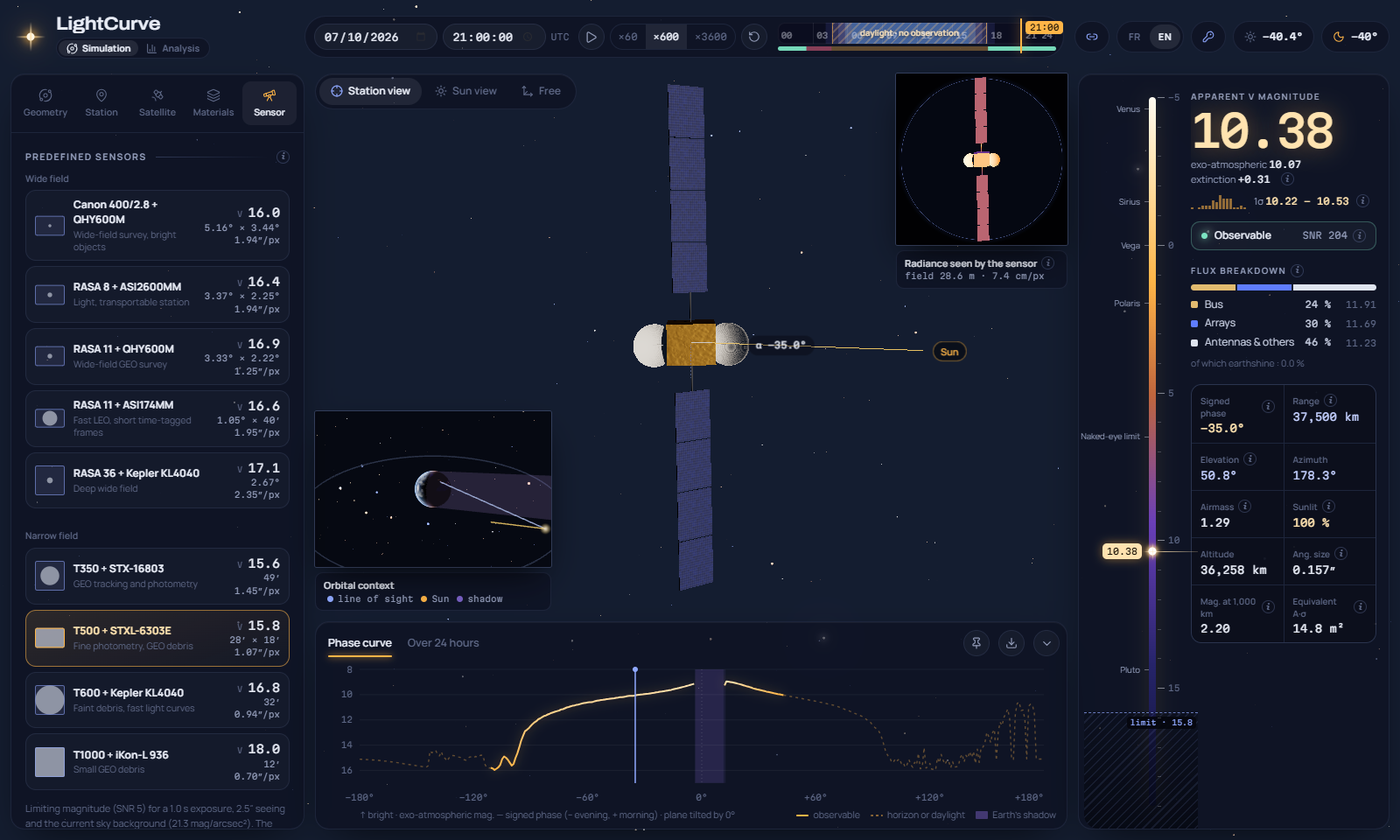
Predefined systems
Section titled “Predefined systems”Each row gives the limiting magnitude (SNR 5) with the current exposure, seeing and sky, the field of view and the pixel scale. A small drawing shows the field at the scale of the full Moon.
| Family | System | Field of view |
|---|---|---|
| Wide field | Canon EF 400 mm f/2.8 + QHY600M | 5.2° × 3.4° |
| Celestron RASA 8 + ZWO ASI2600MM | 3.4° × 2.3° | |
| Celestron RASA 11 + QHY600M | 3.3° × 2.2° | |
| Celestron RASA 11 + ZWO ASI174MM (global shutter) | 1.05° × 0.66° | |
| Celestron RASA 36 cm + FLI Kepler KL4040 | 2.7° | |
| Narrow field | T350 (PlaneWave CDK14) + SBIG STX-16803, bin 2 | 49′ |
| T500 (PlaneWave CDK20) + SBIG STXL-6303E, bin 2 | 28′ × 18′ | |
| T600 (PlaneWave CDK24) + FLI Kepler KL4040, bin 2 | 32′ | |
| T1000 (1 m Ritchey-Chrétien f/8) + Andor iKon-L 936, bin 2 | 12′ |
T350 to T1000 name instrument classes by aperture (mm). Values come from the manufacturers’ data sheets; the quantum efficiency is the V-band one.
Configuration
Section titled “Configuration”Combine any of the 8 telescopes and 9 cameras (CMOS, sCMOS, CCD) with a binning of 1 to 4. The panel shows aperture, focal length and f-ratio, field, pixel scale, total efficiency (optical transmission × quantum efficiency), effective read noise and pixel full well. Detailed settings describe any other instrument.
Binning groups n × n pixels: a CCD sums the charges before a single read (same read noise); a CMOS reads every pixel and then sums them (read noise × n). The full well grows by n².
Acquisition
Section titled “Acquisition”Exposure time and seeing (FWHM). The panel gives the SNR, the limiting magnitude, the signal and background electrons, and the electrons in the brightest pixel. Above the full well, the verdict shows saturated and the panel suggests a shorter exposure.
Photometric band
Section titled “Photometric band”The engine integrates sunlight in V. In the Acquisition section, pick the band of the measurements: V, B, R (Cousins), I (Cousins), Gaia G or unfiltered CMOS. In another band, LightCurve accounts for:
| Effect | Rule |
|---|---|
| Colour of the Sun | m_band = m_V + (M☉,band − M☉,V): B − V = +0.63, V − R = +0.36, V − I = +0.72 |
| Colour of the materials | Reflectance of each material in the band relative to V (gold MLI reflects more red, solar cells more blue), weighted by the flux each part sends |
| Extinction | k relative to V: B × 1.65, R × 0.7, I × 0.45, G × 0.8, unfiltered × 0.85 |
| Sky background | Dark sky relative to V: B +0.9, R −0.7, I −1.8, G −0.4, unfiltered −0.5 mag/arcsec² |
| Sensor | Photons of a magnitude-0 source over the band and detector response, for the SNR and the limiting magnitude |
The curves use the material mix of the current instant. Picking the band of the measurements removes a bias of a few tenths of a magnitude, notably against networks that observe unfiltered. Part of the Simulations plan.
Constraints and sky
Section titled “Constraints and sky”- Ground: maximum Sun elevation (−12°) and minimum satellite elevation (10°).
- Orbit: Sun exclusion (40°) and minimum limb clearance (5°).
- Sky background: estimated from the Sun and the Moon, or entered. See Sky and SNR.