Build a scene
Attitude and rotation
Attitude laws, Euler angles, spin, free tumbling and attitude ephemerides.
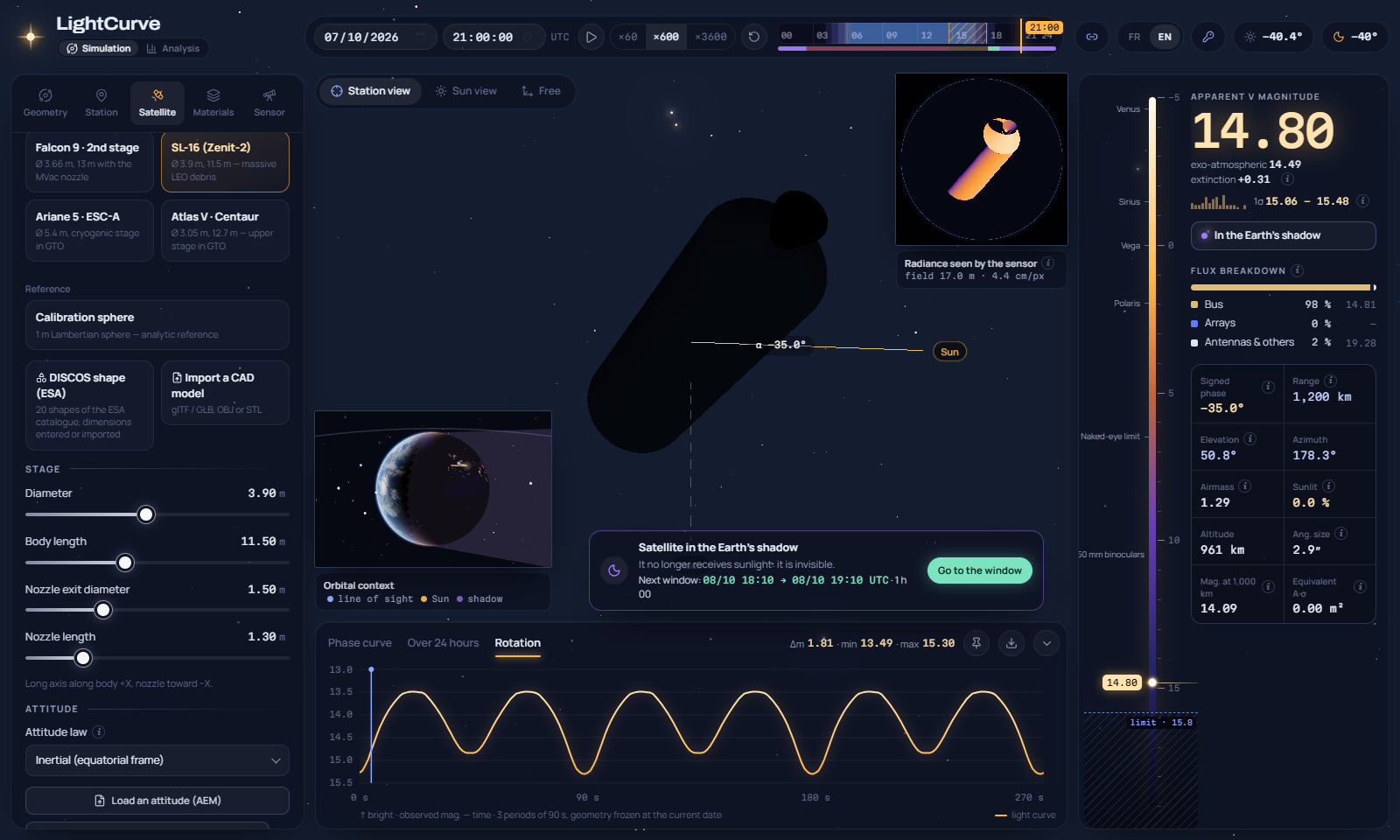
Attitude laws
Section titled “Attitude laws”| Law | Body frame |
|---|---|
| Nadir — N/S array axis (GEO-like) | +Z toward the Earth, +Y toward the south celestial pole; with a known orbit, +Y opposite the orbit normal (LVLH) |
| Nadir — yaw steering | +Z toward the Earth, +Y kept perpendicular to the Sun so the arrays can face it exactly |
| Sun pointing | +X toward the Sun, +Z as close to nadir as possible |
| Inertial | Axes of the equatorial frame |
| Attitude ephemeris (CCSDS AEM) | Quaternions of a loaded AEM file, interpolated |
Then the Euler angles apply (yaw about Z, pitch about Y, roll about X), then the rotation, then the array angle.
Solar arrays
Section titled “Solar arrays”With Sun-tracking arrays, the arrays turn about +Y so that their normal is as close to the Sun as possible; the offset adds an angle. Without tracking, the slider sets the array angle.
Rotation
Section titled “Rotation”Turn on Put the satellite in rotation:
| Mode | Behaviour |
|---|---|
| Fixed axis | Uniform rotation of period P about an axis fixed in the body (X, Y, Z or any direction) |
| Free tumbling | Torque-free motion (Euler’s equations) from an initial axis and period: when the axis is not a principal axis, it precesses and nutates |
For free tumbling, set the three principal moments of inertia (relative), or estimate them from the bounding box of the model. The animation runs in real time at ×¼, ×1 or ×10.
Attitude ephemeris (AEM)
Section titled “Attitude ephemeris (AEM)”Load an attitude (AEM) reads a CCSDS Attitude Ephemeris Message with QUATERNION data and switches the law to it. The body axes of the file are taken as those of the model; the Euler angles correct a different convention. Export the attitude writes the current attitude over ±1 hour with a 10 s step. See CCSDS formats.